LiDAR ranging · static-scene precision characterization
Static-Scene Noise
254 consecutive frames of an unchanging office scene, 8×8 zones. Most of the array holds frame-to-frame noise around 0.3% of range; a few zones sitting on a real depth discontinuity are noisier, by as much as 15×. Repeating the run with the room lights off changes neither — the active-illumination ranging is unaffected by ambient light in this scene.
- Part
- ST VL53L8CX, 8×8 zones, SATEL-VL53L8 breakout
- Device
- cali.EGG68 (nRF9151), shared I²C bus with Grid-EYE/accelerometer
- Scene
- stable office scene, unchanged between runs
- Conditions
- room lights on, then off — two independent 254-frame series
- Source
- live device-log stream, ~200–250 ms/frame (I²C round-robin collection loop)
- Field
- distance_mm, 64 zones
Summary
Across the 48 zones that view a single, far, flat surface, per-zone standard deviation is tight and consistent: a median of 5.7 mm against a mean distance near 1.8 m, about 0.3% relative noise. The 16 zones in the two columns closest to a real depth edge (range drops from ~1.8 m to ~0.6–0.95 m across that boundary) are both noisier and far less consistent with each other — median std 10 mm, one zone as high as 75–93 mm. Turning the room lights off and repeating the full 254-frame run changed neither pattern.
Flat-region noise
5.7 mm
median std, 48 zones, ~0.3% of range
Depth-edge noise
10–93 mm
median–max std, 16 zones on the boundary
Ambient light effect, distance
≤11 mm
max per-zone shift, lights on vs off
Ambient light effect, noise
≈0
flat-region std unchanged within 0.3 mm
The setup
The scene is an ordinary, unmodified office: a stable mix of surfaces at
different distances, nothing staged or targeted for this test. It didn't move
between any of the runs described here. Rather than issuing individual
cal tof raw shell commands, both 254-frame series were read
straight off the device's own live log stream — the I²C round-robin
collection loop (see the project overview for the
scheduler/cache architecture) already pushes a fresh distance frame roughly
every 200–250 ms whenever the LiDAR's schedule is on, so 254 frames
is about a minute of passive listening, not 254 separate commands.
Two independent series were captured back to back, same scene, same sensor configuration: room lights on, then room lights off. Per-zone mean and standard deviation are computed across all 254 frames in each series.
Flat region vs. the depth edge
The 8×8 array splits cleanly into two regimes. Columns 0–5 look at one far surface the whole time — mean distance is smooth and continuous across all 48 of those zones (1782–1851 mm), and every one of them holds a standard deviation between 4.7 and 8.8 mm. Columns 6 and 7 straddle a real edge in the scene: mean distance drops abruptly, from ~1.8 m in column 5 to 900–950 mm in column 6 to 600–870 mm in column 7. The standard deviation in that same region is both higher on average and far less consistent zone to zone — a few zones sit at 50–75 mm while their immediate neighbors are under 10 mm.
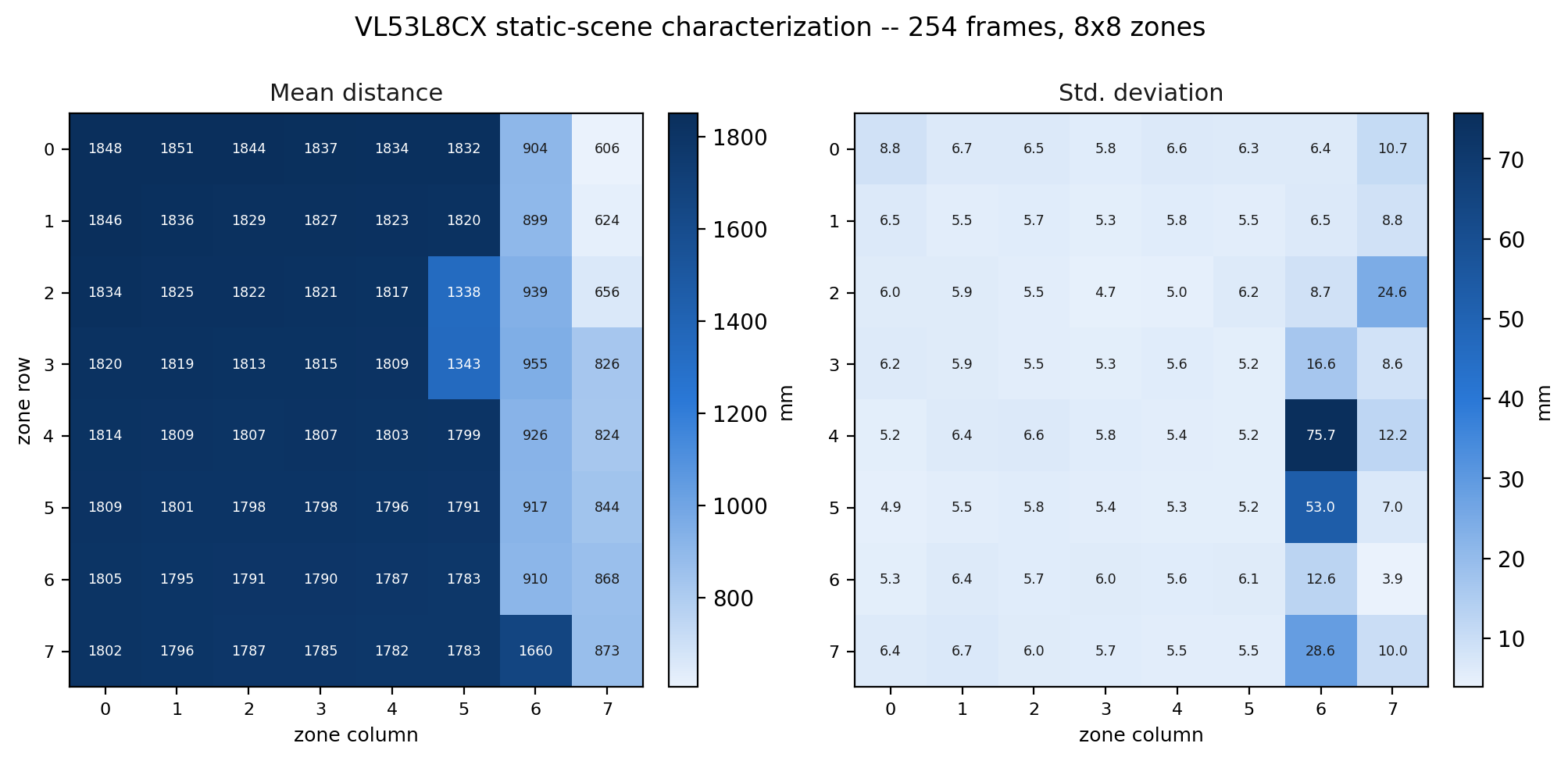
That pairing is the expected signature of a mixed-pixel (edge) effect: a zone whose field of view spans two surfaces at different ranges returns a distance that depends on exactly how the return energy splits between them frame to frame, which is inherently less repeatable than a zone looking at one flat surface. It is a property of where the zone sits relative to the scene, not a fault spread across the sensor — the 48 single-surface zones never show it.
Ambient light: no measurable effect
The VL53L8CX ranges by timing its own 940 nm VCSEL pulse, not by passively imaging the scene, so ordinary room lighting is not expected to change what it reports. Repeating the full 254-frame series with the office lights off, same scene, confirms that directly rather than assuming it.
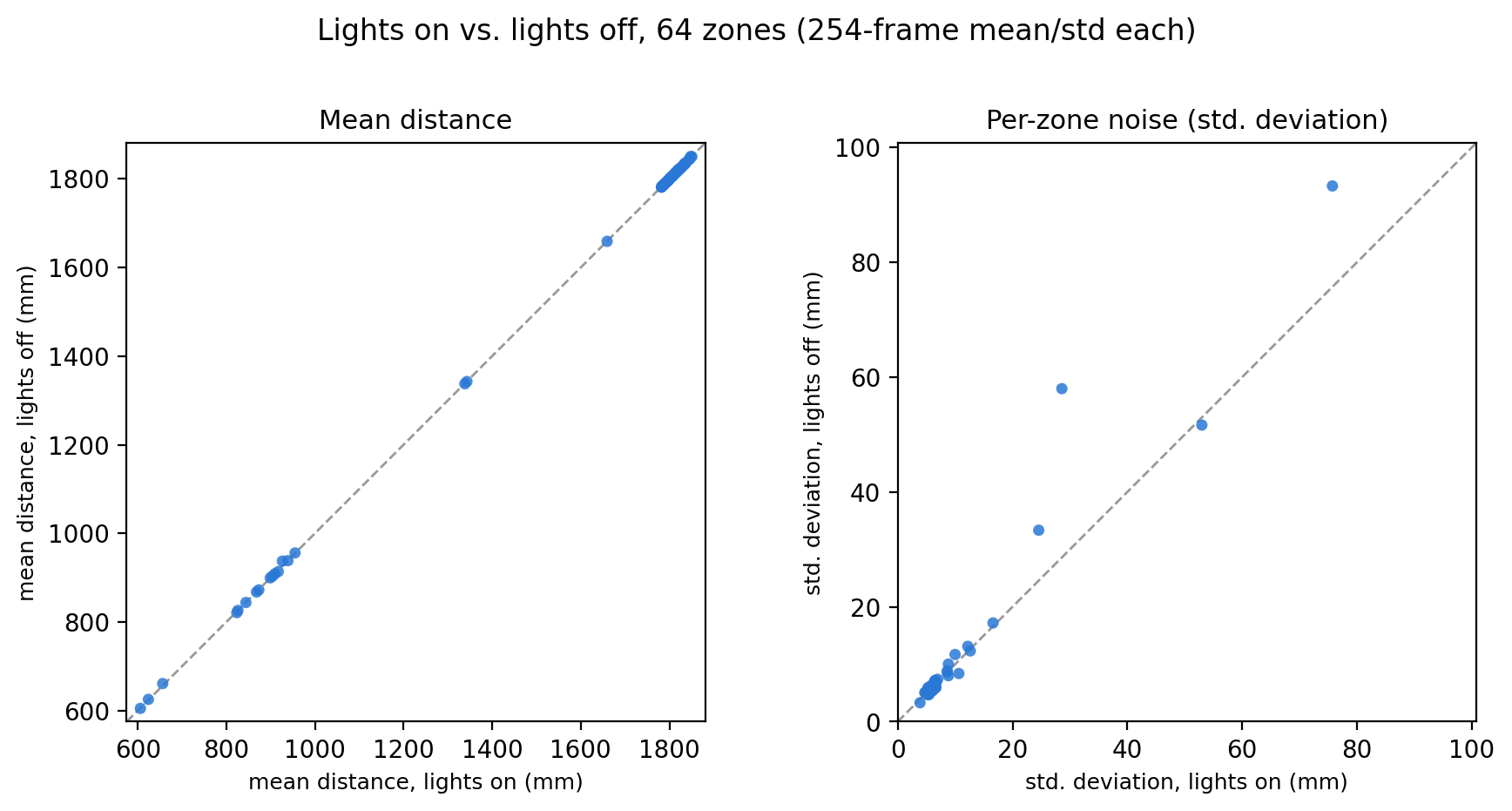
Per-zone mean distance moved by 1.0 mm on average between the two conditions (11.0 mm at the single largest zone, still inside that zone's own frame-to-frame noise). Flat-region standard deviation moved by 0.33 mm on average — the median across those 48 zones was 5.71 mm with the lights on and 5.65 mm with them off. Neither difference is distinguishable from ordinary run-to-run variation.
Method & caveats
- Data source is the device's own CoAP-send log line (
Sending lidar
      frame: ... dist=...
), read passively off the live UART log stream while the commissioning schedule was running — not individualcal tof rawcaptures. Onlydistance_mmis logged this way; the richer per-target diagnostic fields used in the window-transmission study (signal_per_spad, range_sigma_mm, etc.) were disabled at the source in 2026-10-02 to cut per-frame I²C time, see that page andlidar.h's own notes — not available here. - Single scene, single sensor, one distance range (~0.6–1.85 m). No claim here about how the flat-region noise floor or the edge-effect magnitude scale with distance, incidence angle, or target reflectance.
- "Flat region" / "depth edge" is a post-hoc split based on where the mean distance actually discontinues in this particular scene (columns 0–5 vs 6–7), not a property fixed to those column indices in general — point the sensor at a different scene and a different set of zones will straddle whatever edge is there.
- Standard deviation is computed per zone across all 254 frames of a
series; frames with a non-zero status were excluded (none were, in either
series — all 254/254 came back
status=0in both runs).
Data: two 254-frame series (lights on, lights off), same office scene, 2026-10-04. Raw per-zone distance series held in the device project repository, not published here.